Cliquer sur les images ci-dessus
PARTENAIRE AMAZON ► En tant que partenaire d'Amazon, le site est rémunéré pour les achats éligibles.
Patrick AULNAS
Au 13e siècle, en Italie, les peintres se contentaient de reproduire les modèles byzantins canoniques. La prohibition du réalisme conduisait à des figures religieuses hiératiques sur fond or et à des accessoires décoratifs stylisés. Cimabue joue un rôle important en commençant à humaniser les personnages. Il leurs prête des sentiments humains totalement absents de l’art byzantin.
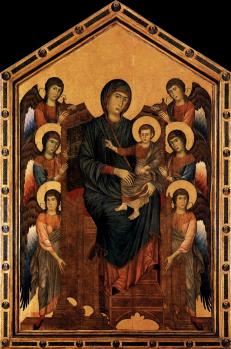
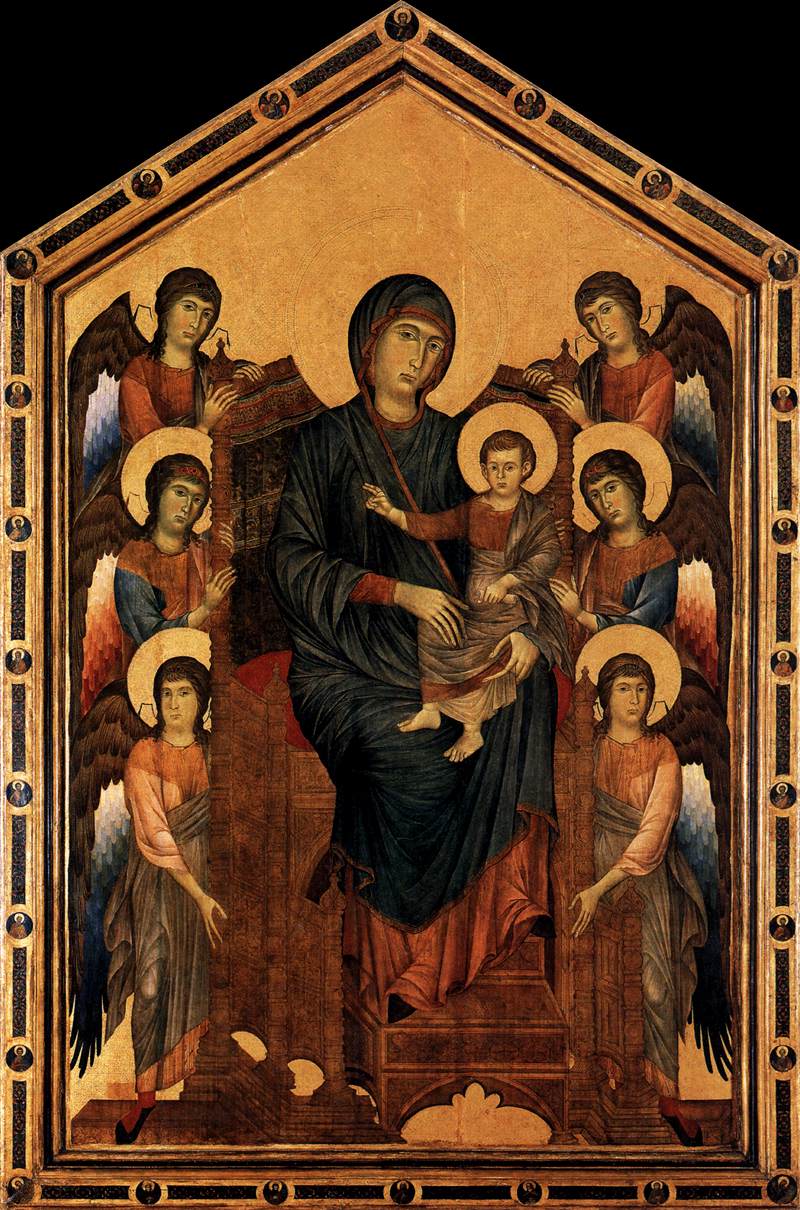
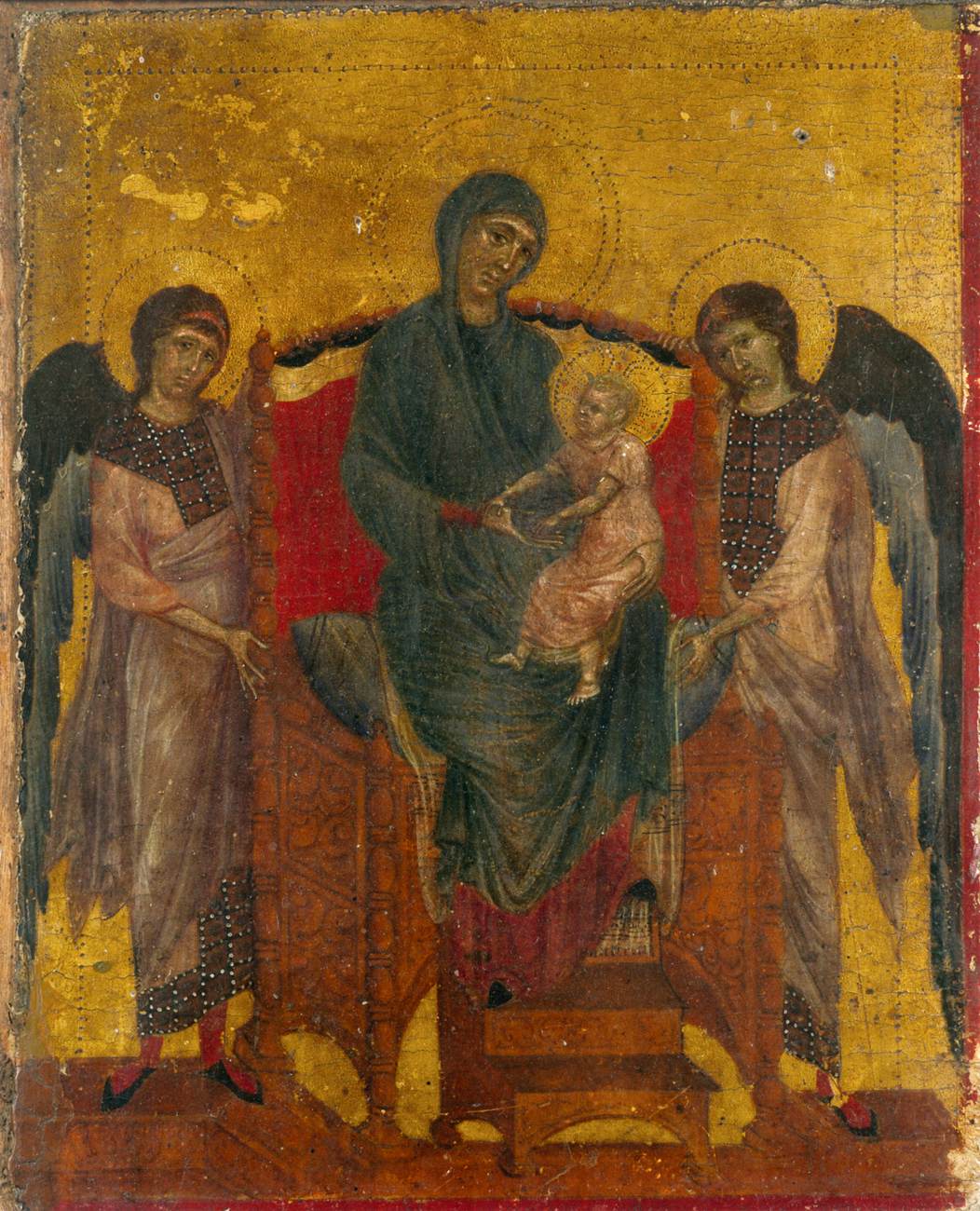
Cimabue. La Vierge et l'Enfant en majesté entourés d'anges (v. 1280)
Tempera sur bois, 427 × 280 cm, musée du Louvre, Paris.
Image HD sur MUSÉE DU LOUVRE
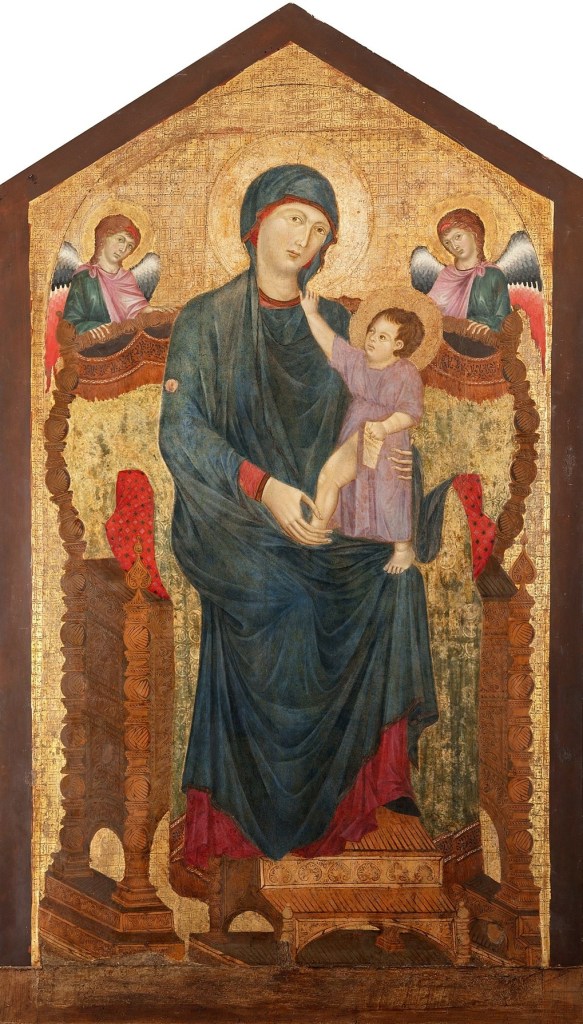
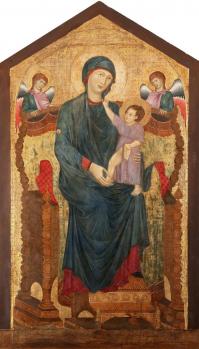 Cimabue. Vierge en majesté ou Maestà di Santa Maria (1280-90)
Tempera sur bois, 218 × 188 cm, basilique Santa Maria dei Servi, Bologne.
Image HD sur WIKIMEDIA
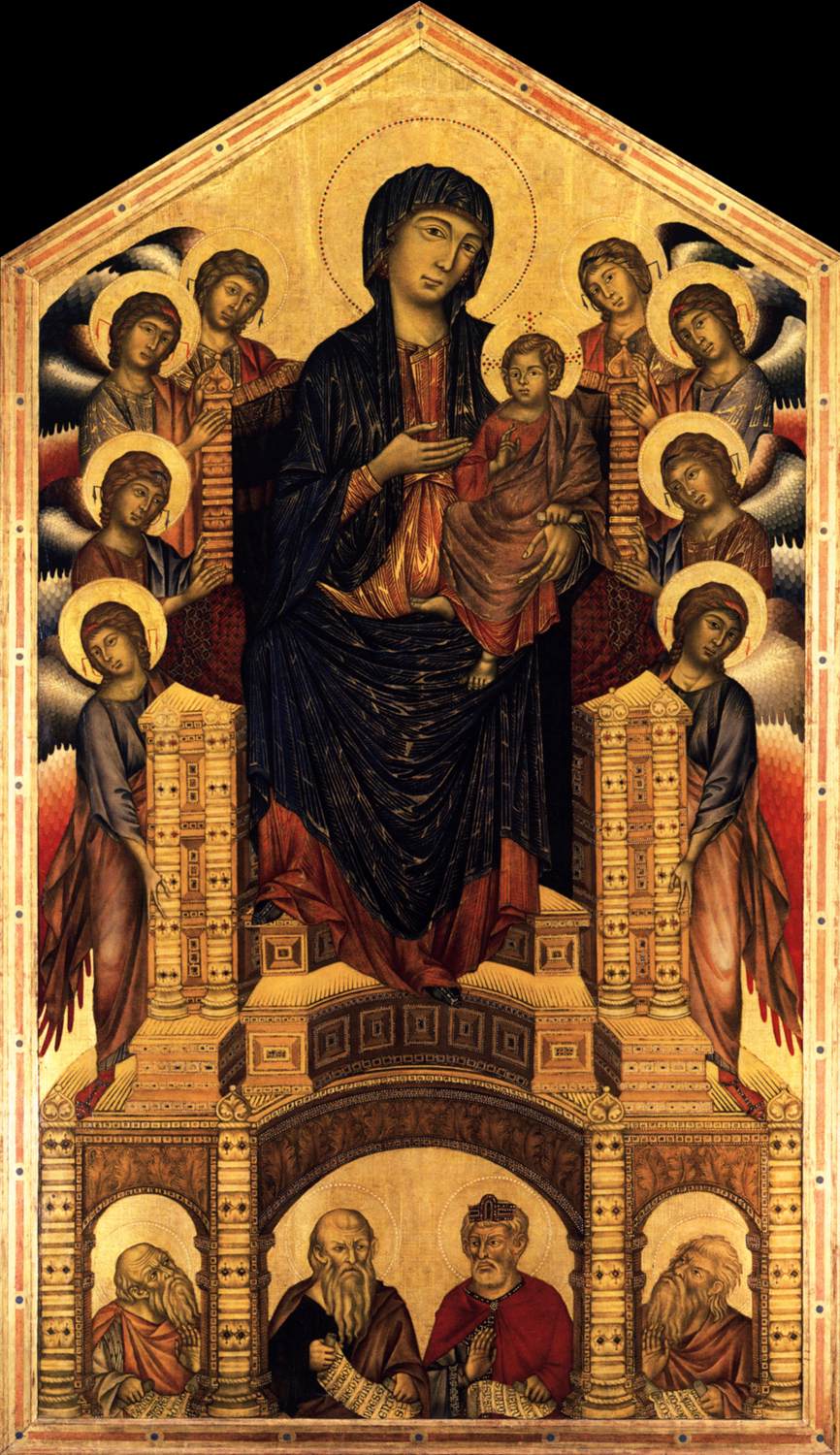
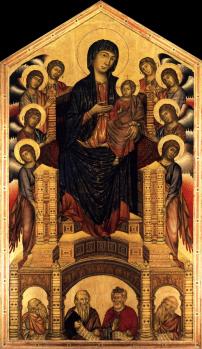 Cimabue. La Vierge en majesté ou Maestà di Santa Trinita (1285-86)
Tempera sur bois, 385 × 223 cm, Galerie des Offices, Florence.
Image HD sur GOOGLE ARTS & CULTURE
Contexte historique : évolution de la figure de la Vierge
Les Vierges de Cimabue constituent une évolution notable de la représentation de la Vierge en peinture. Cette évolution se place sur une trajectoire allant de la Vierge en majesté (Maestà) provenant de l’art byzantin à la Vierge de l’humilité (Madone) qui commence à apparaître dans la seconde moitié du 14e siècle.
Les évolutions picturales étant permanentes, il est impossible de situer un point de départ et un point d’arrivée. Mais les œuvres suivantes fournissent des repères visuels.
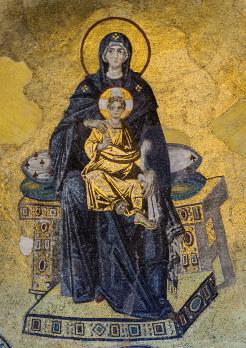
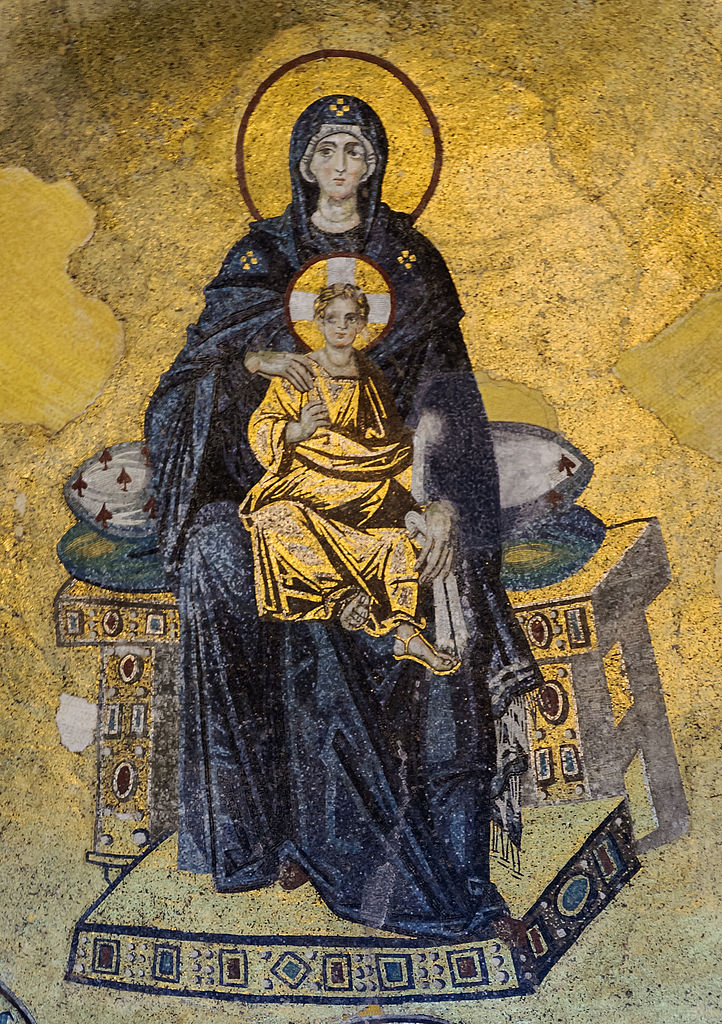
La Vierge et l'Enfant ou Théotokos (9e siècle)
Mosaïque, Basilique Sainte-Sophie, Istanbul
La Vierge est assise sur un siège très stylisé, conformément à la doxa byzantine de l'époque qui excluait le réalisme.
Le fond or permet également d'éviter toute tentation de ce point de vue.
La figure hiératique de la Vierge respire la majesté mais exclut toute émotion.
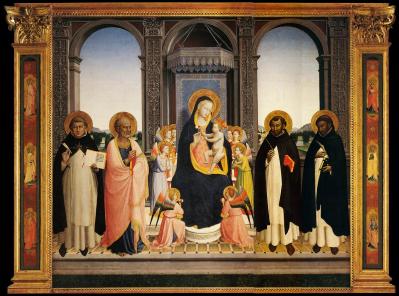
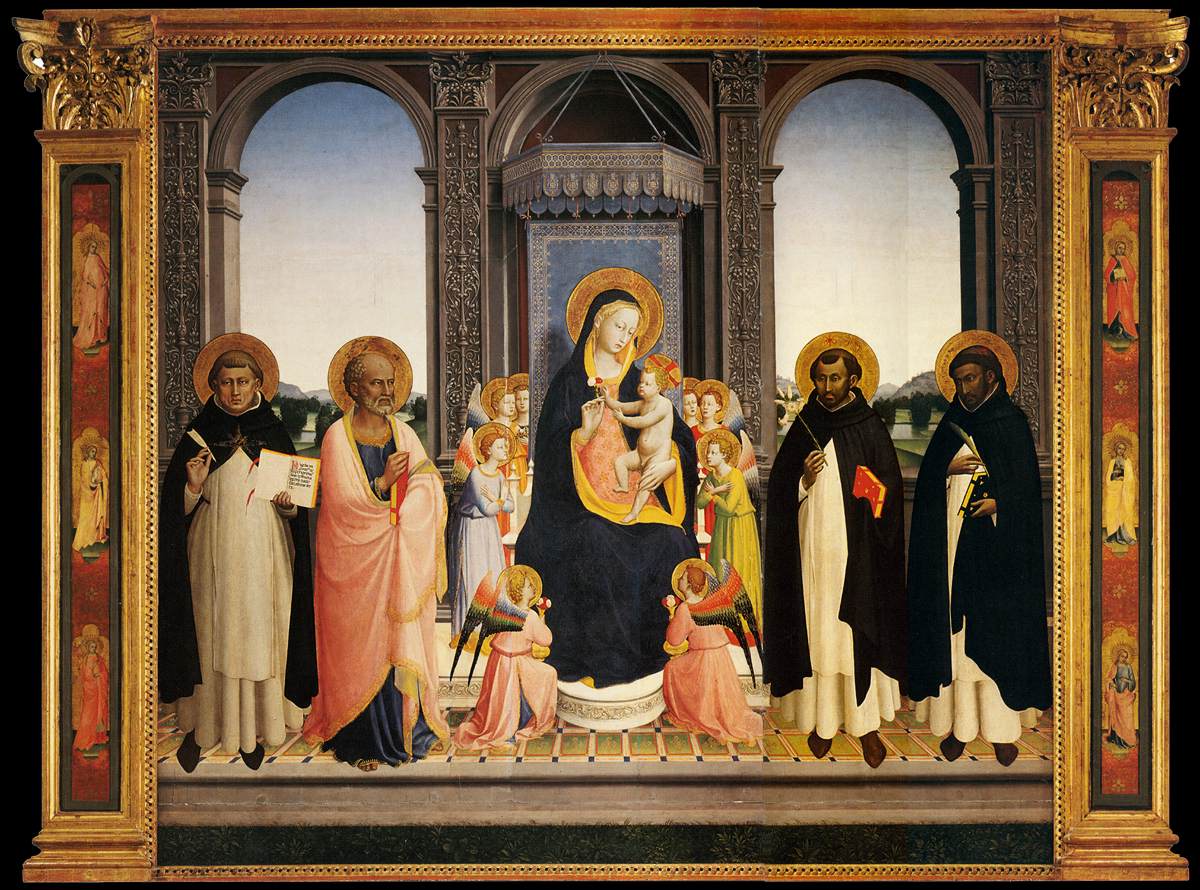
Fra Angelico. Retable San Domenico ou Pala di Fiesole (1423-24)
Tempera et or sur bois, 212 × 237 cm, San Domenico, Fiesole.
Analyse détaillée
Six siècles plus tard, Fra Angelico propose une Vierge encore assise sur un trône majestueux,
mais le personnage s’est humanisé et joue avec le Christ enfant.
Le visage de la Vierge est incliné vers son fils et son regard ne se perd plus dans les lointains.
La Vierge est devenue une figure maternelle. Le paysage apparaît à l’arrière-plan.
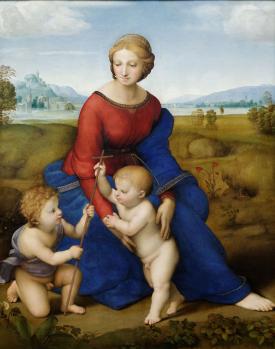
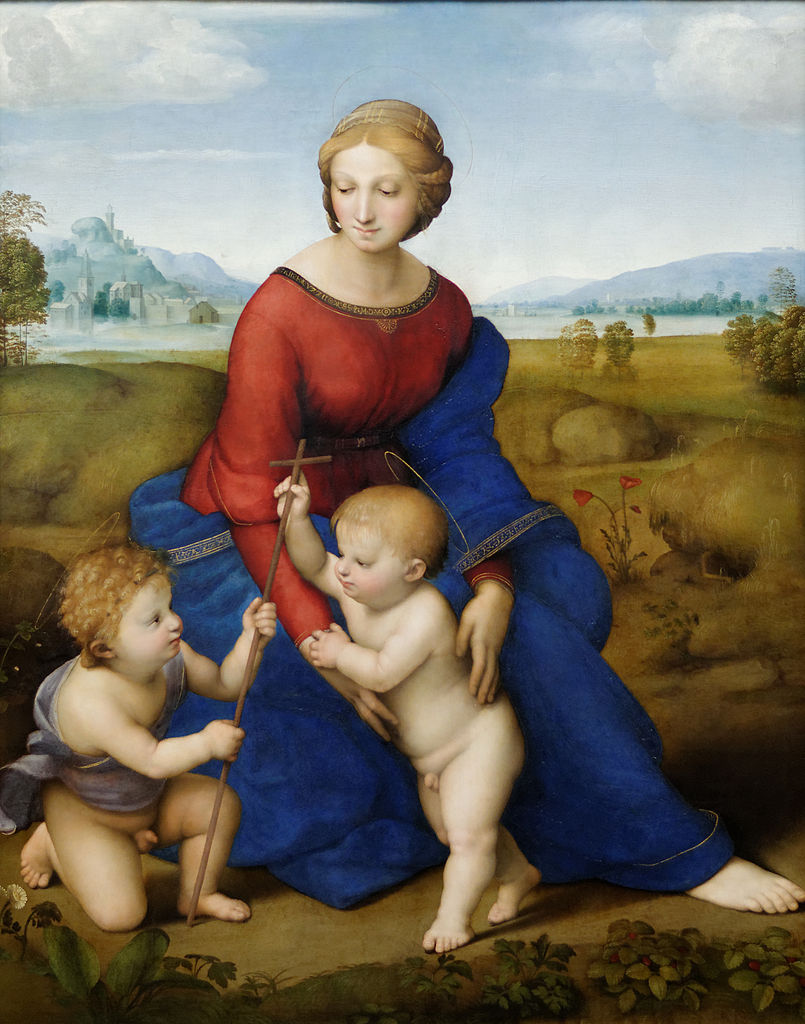
Raphaël. La Madone à la prairie (1505-1506)
Huile sur bois de peuplier, 113 × 88,5 cm, Kunsthistorisches Museum, Vienne, Autriche.
Analyse détaillée
Environ un siècle plus tard, la figure de la Vierge est celle d’une mère assise dans une prairie avec des enfants.
Le cadre architectural a disparu. L’auréole entourant la tête est réduite à un cercle à peine visible.
L’habillement reste somptueux pour l’époque mais toute solennité a été abandonnée.
Les Maestà de Cimabue se placent entre la Théotokos byzantine (Théotokos : Mère de Dieu) et la Vierge à l’enfant de Fra Angelico. Mais quelles sont les innovations qui les caractérisent ?
Analyse des trois œuvres
Il s’agit de trois Maestà ou Vierges en majesté. La Vierge, entourée d’anges, est placée sur un trône symbolisant sa majesté : elle est la reine des cieux. Ce trône est devenu beaucoup plus imposant que celui de la Théotokos byzantine, qui était réduit à un simple siège. Cimabue cherche visiblement le réalisme perspectif, mais il n’en connaît pas les règles mathématiques. La représentation du trône reste donc assez schématique. Dans les trois compositions, le fond or de l’art byzantin est conservé. Mais le peintre s’efforce d’apporter des éléments décoratifs originaux.
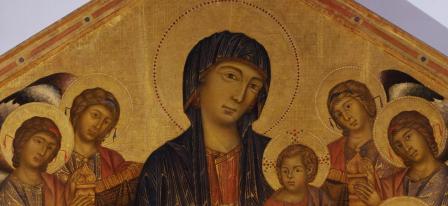
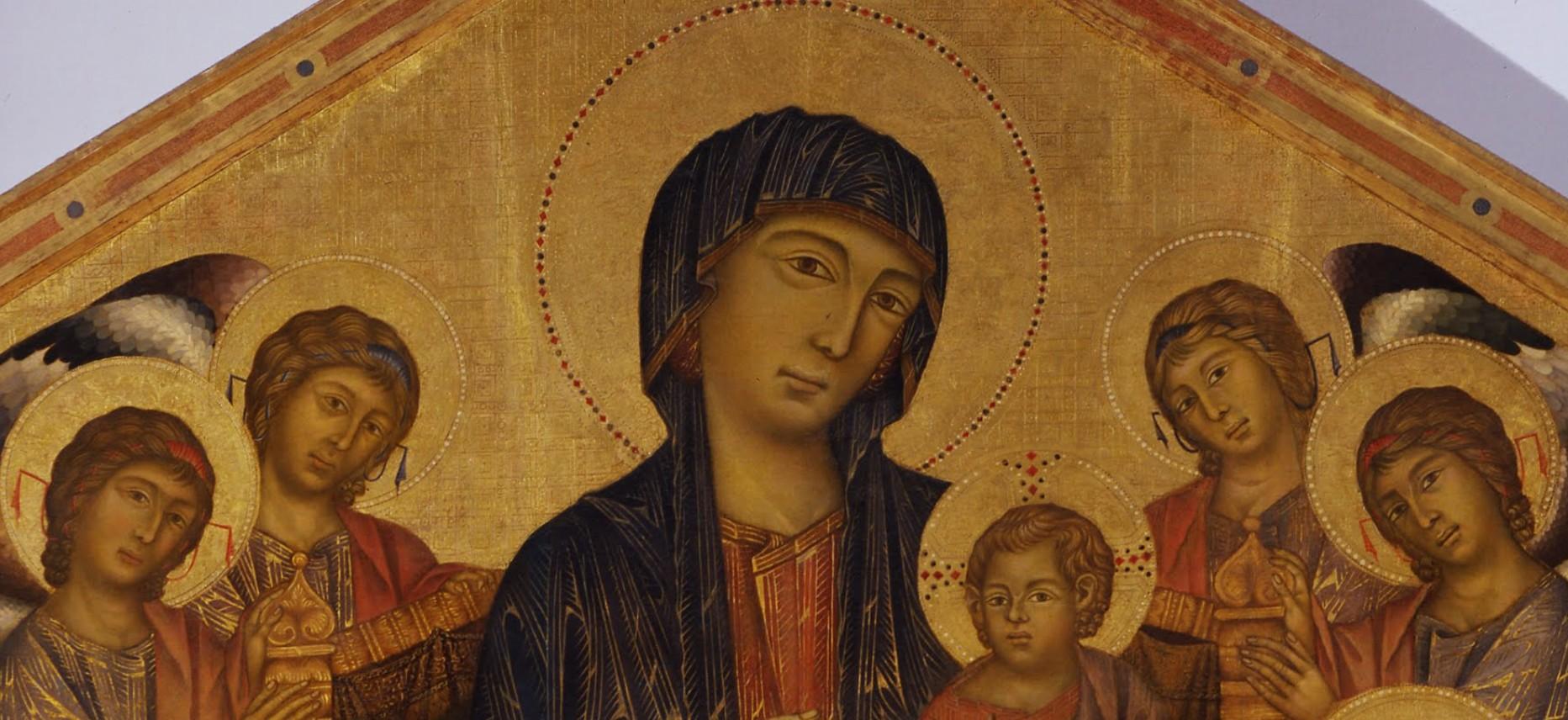
Cimabue. La Vierge en majesté ou Maestà, détail, Galerie des Offices (1285-86)
L’hiératisme de la Vierge byzantine subsiste par la position centrale d’un personnage solennel, beaucoup plus grand que les anges qui l’entourent. Le visage de la Vierge n’est pas maternel mais d’une extrême gravité, préfiguration du destin tragique du Christ. Pourtant, ce visage n’est plus réduit à une esquisse austère mais étudié avec soin pour faire ressortir son humanité. La douceur tragique obtenue par le jeu de l’ombre et de la lumière représente le tout début d’une évolution de plusieurs siècles.
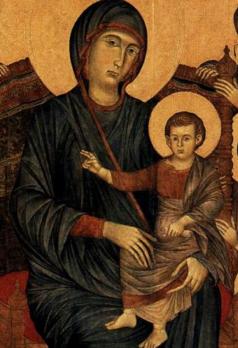
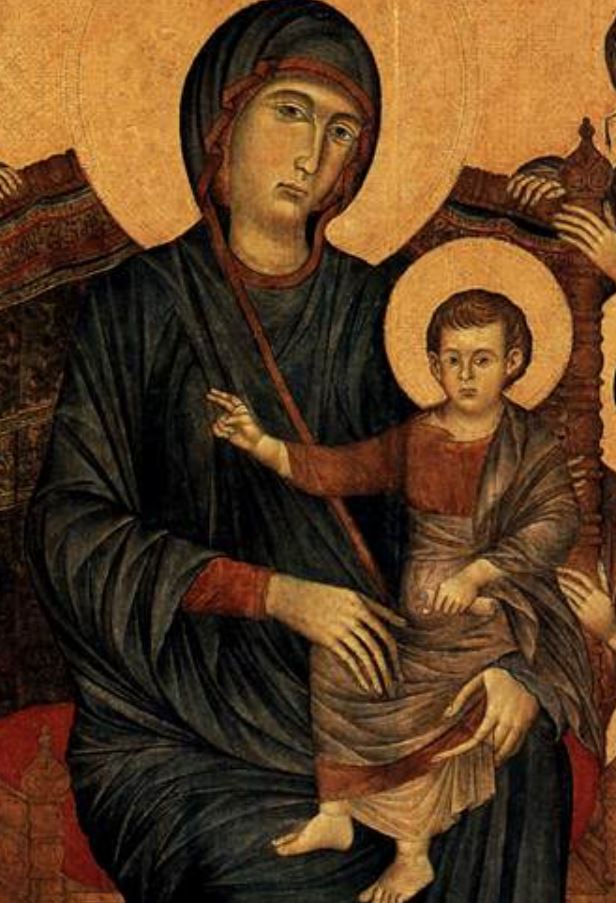
Cimabue. La Vierge et l'Enfant en majesté entourés d'anges, détail, musée du Louvre (v. 1280)
L’Enfant Jésus est traité comme un adulte en miniature, représentation révélatrice de la distance de l’univers masculin du peintre par rapport à la petite enfance, domaine à l’époque réservé aux femmes. Cimabue n’a jamais observé le visage, le corps, la gestuelle, les mimiques d’un jeune enfant. Il peint donc un petit adulte, bénissant sur deux des compositions, faisant un geste vers le visage de sa mère sur la troisième. L’Enfant Jésus tient dans sa main gauche un document qui symbolise la parole divine qu’il est venu apporter aux hommes. Tous les visages sont entourés de l’auréole indiquant leur sainteté.
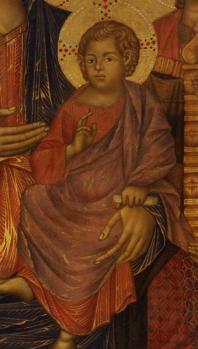
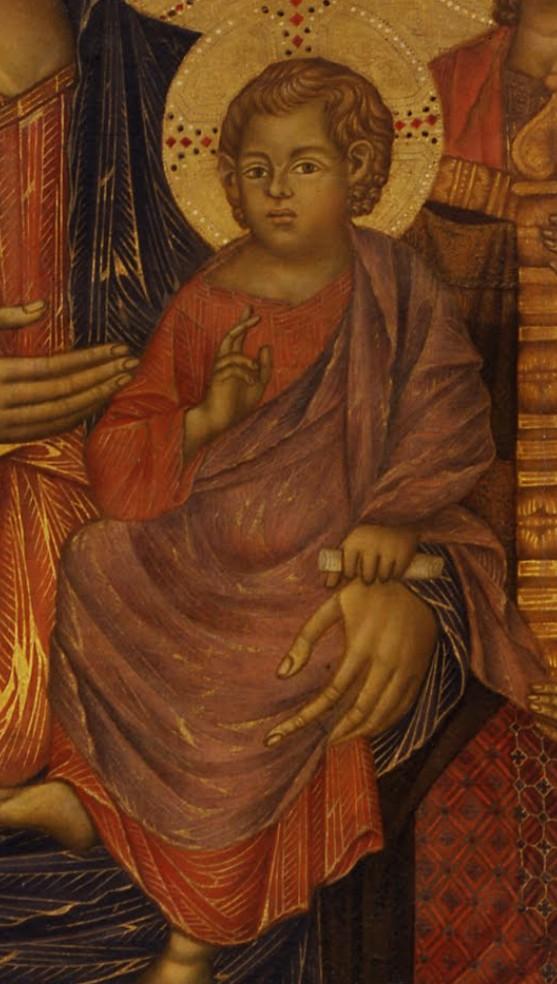
Cimabue. La Vierge en majesté ou Maestà, détail, Galerie des Offices (1285-86)
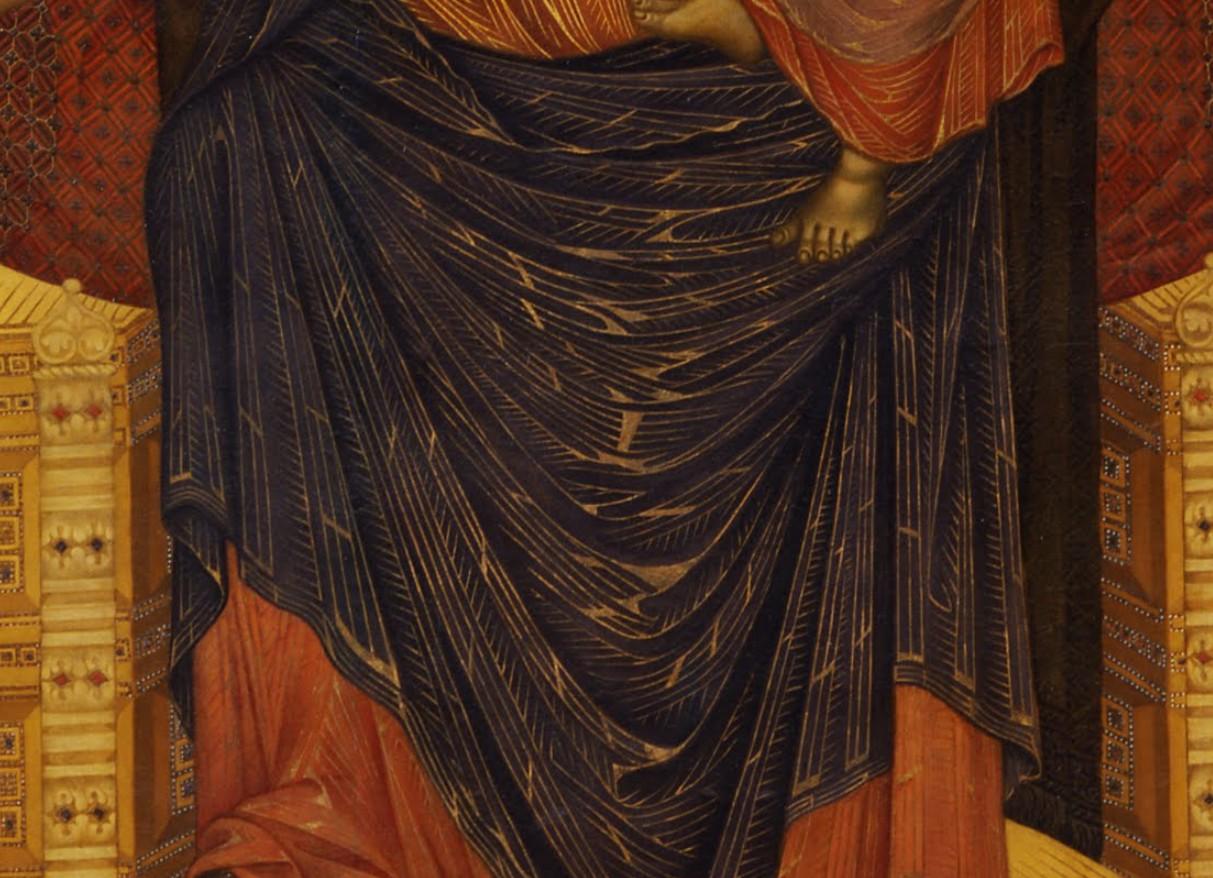
Le soin apporté au drapé est commun aux trois Maestà, en particulier pour le vêtement de la Vierge. Le traitement remarquablement réussi des multiples plis de l’étoffe permet d’accéder à un effet de volume et à la tridimensionnalité, plus subtilement que par l’alignement des saints.
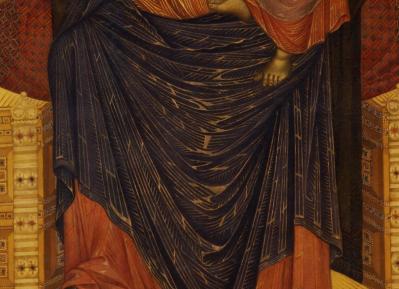
Cimabue. La Vierge en majesté ou Maestà, détail, Galerie des Offices (1285-86)
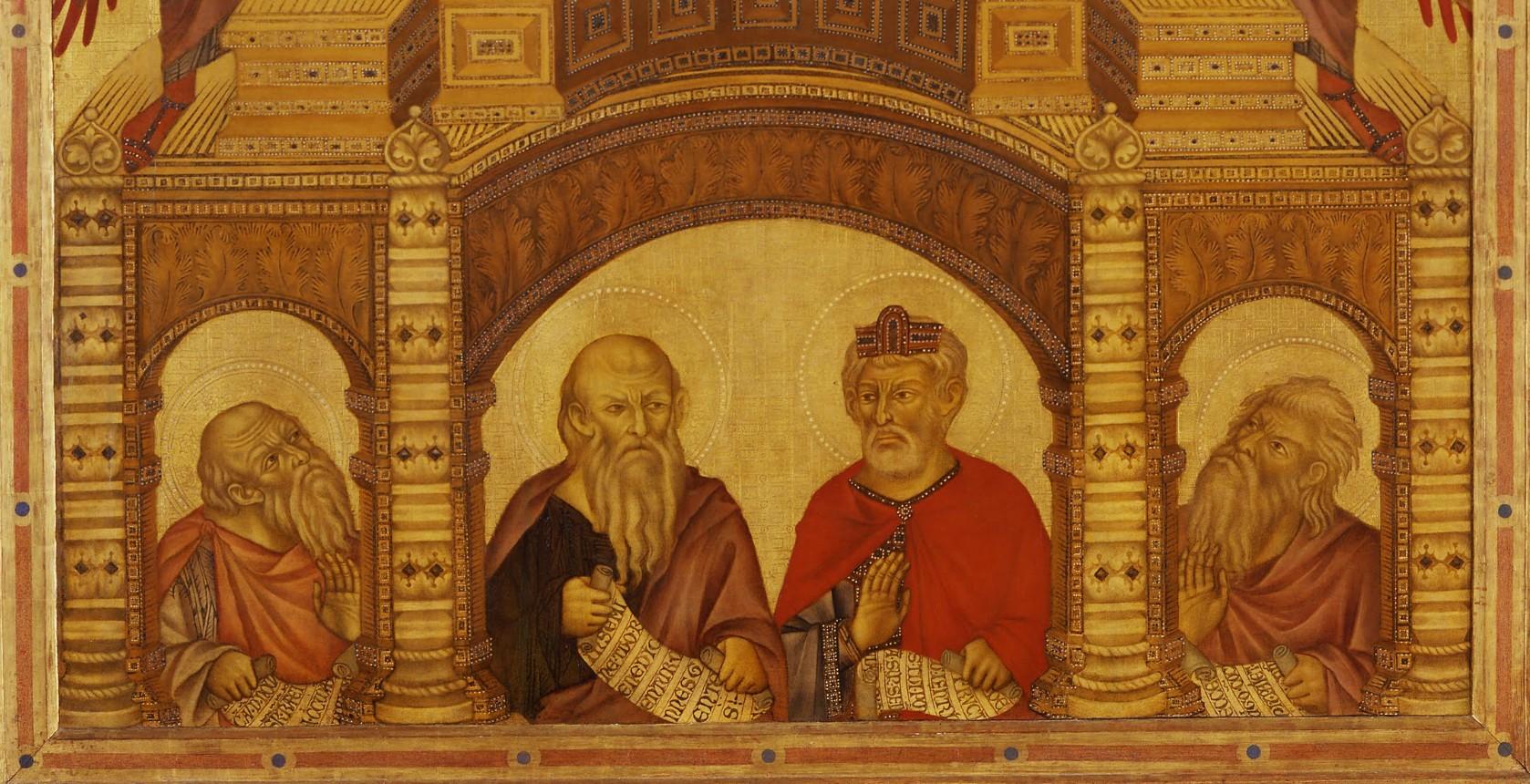
Les Maestà du Louvre et des Offices comportent les mêmes principes généraux de composition : Vierge à l’Enfant sur un trône, entourée de saints alignés, placés symétriquement par rapport au trône et peints sur le même modèle. Mais la Maestà des Offices met puissamment l’accent sur l’aspect architectural. Le trône n’est plus un élément flou qui se dissout dans l’ensemble, mais une véritable architecture complexe comportant des parties concaves simulant la profondeur. Le personnage de la Vierge est surélevé car quatre figures de l’Ancien Testament ont été placées à la base du trône : Jérémie, Abraham, le roi David, et Isaïe. Ce sont des prophètes qui tiennent chacun un rouleau sur lequel apparaît une inscription lisible, extraite de la Bible.
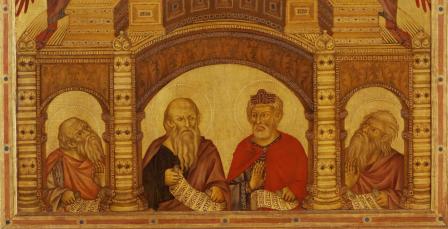
Cimabue. La Vierge en majesté ou Maestà, détail, Galerie des Offices (1285-86)
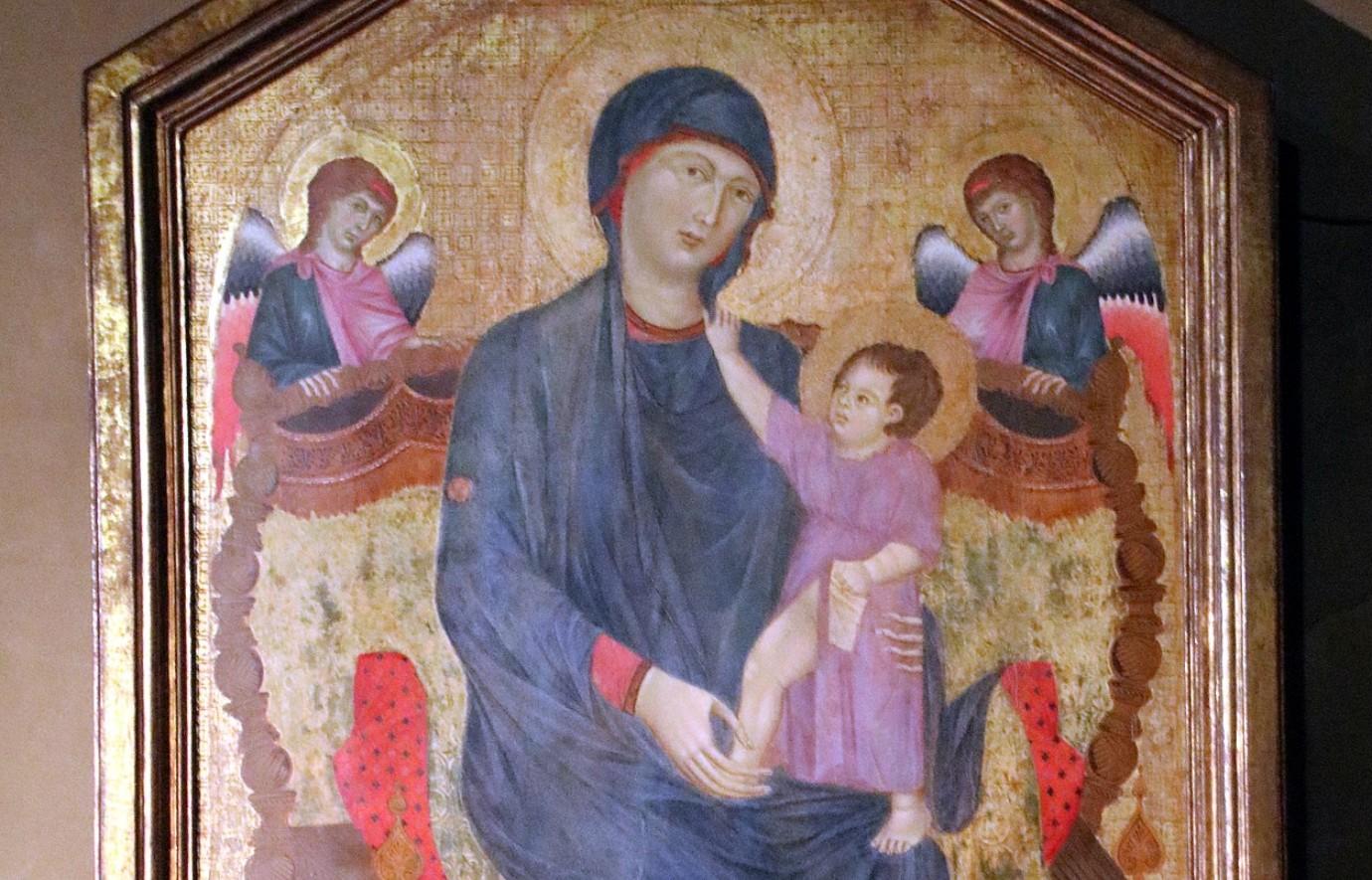
Pour la Maestà de Bologne, Cimabue s’est contenté de deux anges et d’un trône très schématique. La Vierge conserve la même position mais l’Enfant est plus libre et plus vrai avec une jambe apparente et une main cherchant à toucher le visage de sa mère. La recherche de caractéristiques propres à l’enfance est une innovation. Cette composition est aussi nettement moins grande que les deux autres avec une hauteur de deux mètres contre environ quatre. Les commanditaires déterminaient la taille et les principales caractéristiques des œuvres car le prix en dépendait. Plus la peinture était monumentale et complexe, plus elle demandait un long travail qu’il fallait payer. Les commanditaires de la Maestà de Bologne n’ont pas voulu ou pu payer un prix aussi élevé que ceux des deux autres Maestà.
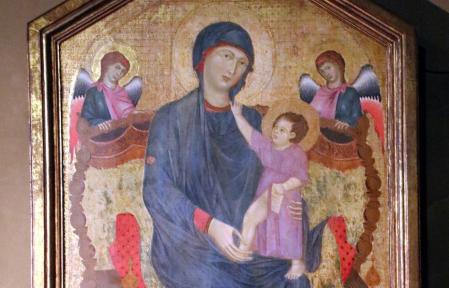
Cimabue. Vierge en majesté ou Maestà, détail, Santa Maria, Bologne (1280-90)
Ces trois Vierges en majesté ne sont pas les seules attribuées à Cimabue (voir ci-après). Mais toutes représentent une évolution importante de la figure de la Vierge par rapport aux canons de l’art byzantin. Seul un très grand artiste pouvait, à la fin du Moyen Âge, initier les caractéristiques essentielles de la peinture de la Renaissance : la recherche des effets de volume et de profondeur ainsi qu’une humanisation véritable des figures religieuses.
Autres compositions de Cimabue sur le même thème
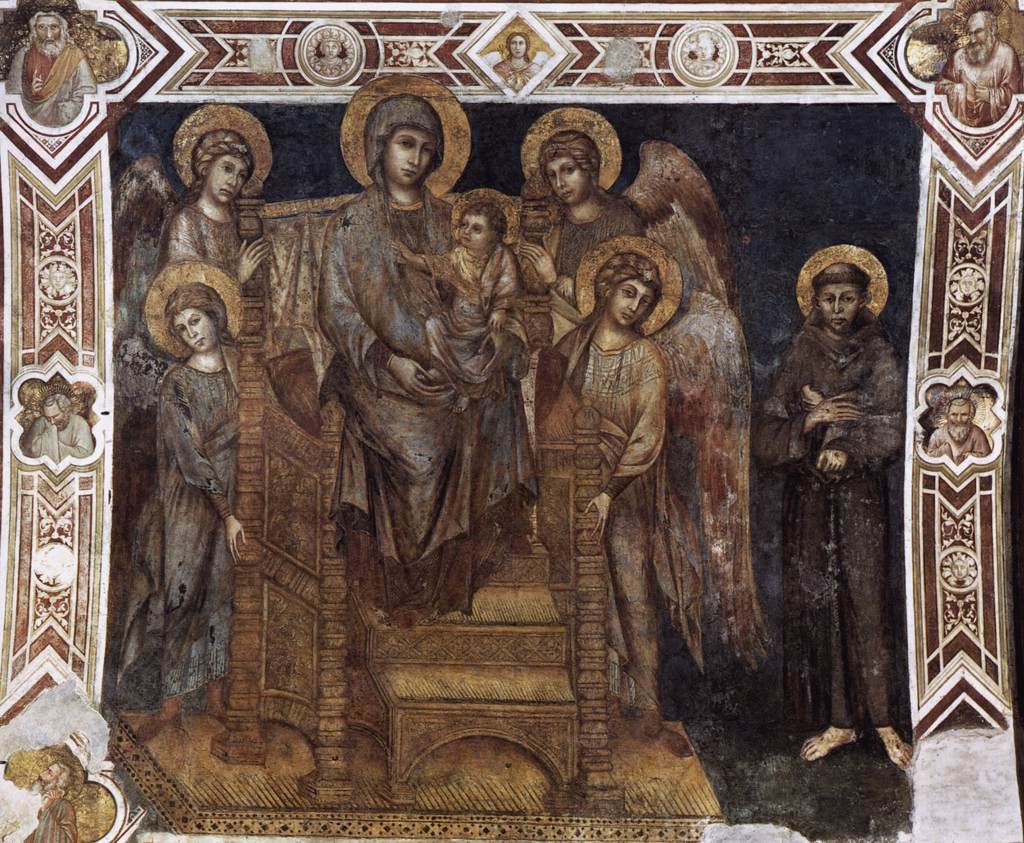
Cimabue. Vierge à l’Enfant avec saint François et quatre anges (1278-80). Fresque, 320 × 340 cm, église inférieure, Saint-François d’Assise. « La fresque se trouve sur le mur est du bras nord du transept ouest de l’église inférieure. C’est l’une des œuvres les plus problématiques de Cimabue concernant sa datation et son état après les repeints du 19e siècle. Compte tenu de sa datation, il est généralement admis, pour des raisons stylistiques, qu’elle est postérieure aux fresques de Cimabue dans l’église supérieure ou à la Madone du musée du Louvre. » (Commentaire WGA) |
Cimabue. Vierge à l’Enfant avec deux anges (1280-85). Tempera sur bois, 26 × 21 cm, National Gallery, Londres. « Il s’agit de l’une des deux seules œuvres à petite échelle de Cimabue, redécouvertes en 2000. Peu de temps après, un lien a été établi avec un panneau de la Frick Collection, à New York, qui représente la Flagellation. Ils faisaient probablement partie tous deux d’un panneau beaucoup plus grand, peint avec de petites images représentant les événements menant à la mort du Christ. Un troisième panneau du même groupe, L’Arrestation du Christ, a été découvert dans une collection privée française en 2019 et fait maintenant partie de la collection du musée du Louvre, à Paris.
Deux anges aux longues ailes emplumées présentent la Vierge à l’Enfant au spectateur. Cette scène fait référence à la souffrance et à la mort du Christ à travers le tissu sur lequel la Vierge est assise. Il ressemble à celui placé sur un autel utilisé pour l’Eucharistie – le rituel au cours duquel les chrétiens se souviennent ensemble de la mort du Christ en buvant du vin et en mangeant du pain. Cette scène est basée sur un modèle byzantin que Cimabue a modifié : il a rendu le trône tridimensionnel et a inclus un geste affectueux entre la mère et l’enfant. Ces ajustements s’adressaient aux chrétiens occidentaux pour qui une relation personnelle avec Dieu était essentielle. » (Commentaire National Gallery) |
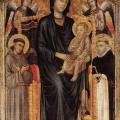
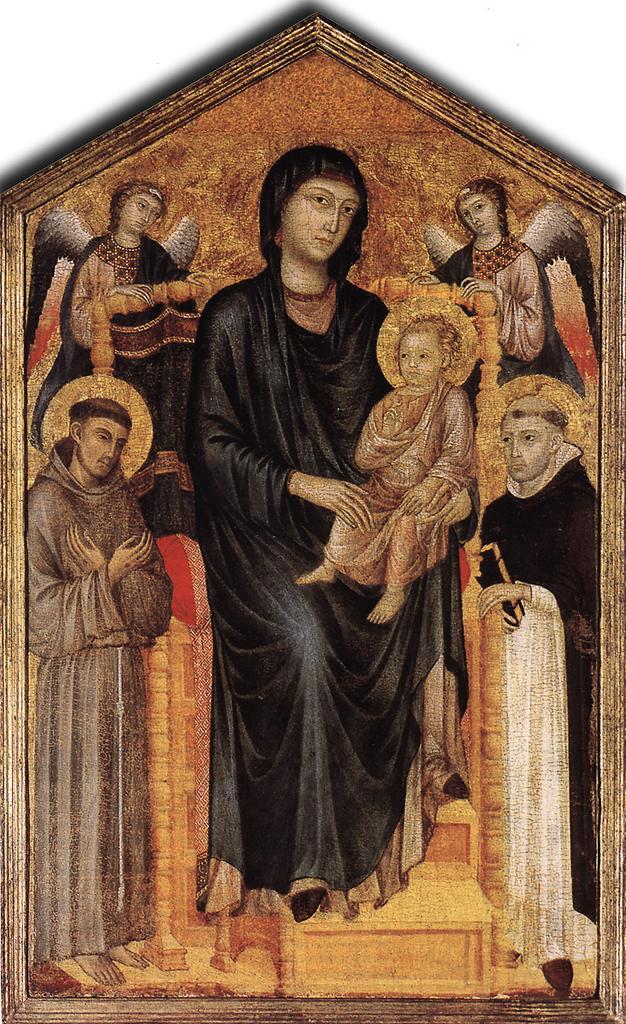
Cimabue. Vierge en majesté avec saint François, saint Dominique et deux anges (1295-1300). Tempera sur bois, 133 × 82 cm, Galerie des Offices, Florence. « La Vierge en majesté avec l’Enfant Jésus sur ses genoux est flanquée de deux saints très vénérés, François d’Assise (1181-1226) et Dominique de Guzmán (1170-1221), fondateurs des ordres religieux qui portent leurs noms. Les deux saints portent des robes généralement associées aux deux ordres. Saint François, dont les mains et les pieds sont marqués de stigmates, porte un habit brun, tandis que saint Dominique porte une tunique blanche sous un manteau noir. L’Enfant Jésus est vêtu comme un homme éminent de l’Antiquité et donne une bénédiction en regardant saint François, qui baisse humblement le regard tout en croisant les mains sur sa poitrine, geste indiquant sa soumission à la volonté divine. Le saint d’Assise prend la place d’honneur à la droite de Marie et de Jésus.
Le trône est représenté par projection oblique. Cette technique a été utilisée par les peintres dans la seconde moitié du XIIIe siècle pour représenter la tridimensionnalité et créer de la profondeur. Le caractère concret du trône est souligné par les deux anges qui posent leurs mains sur son dossier. » (Commentaire Galerie des Offices) |